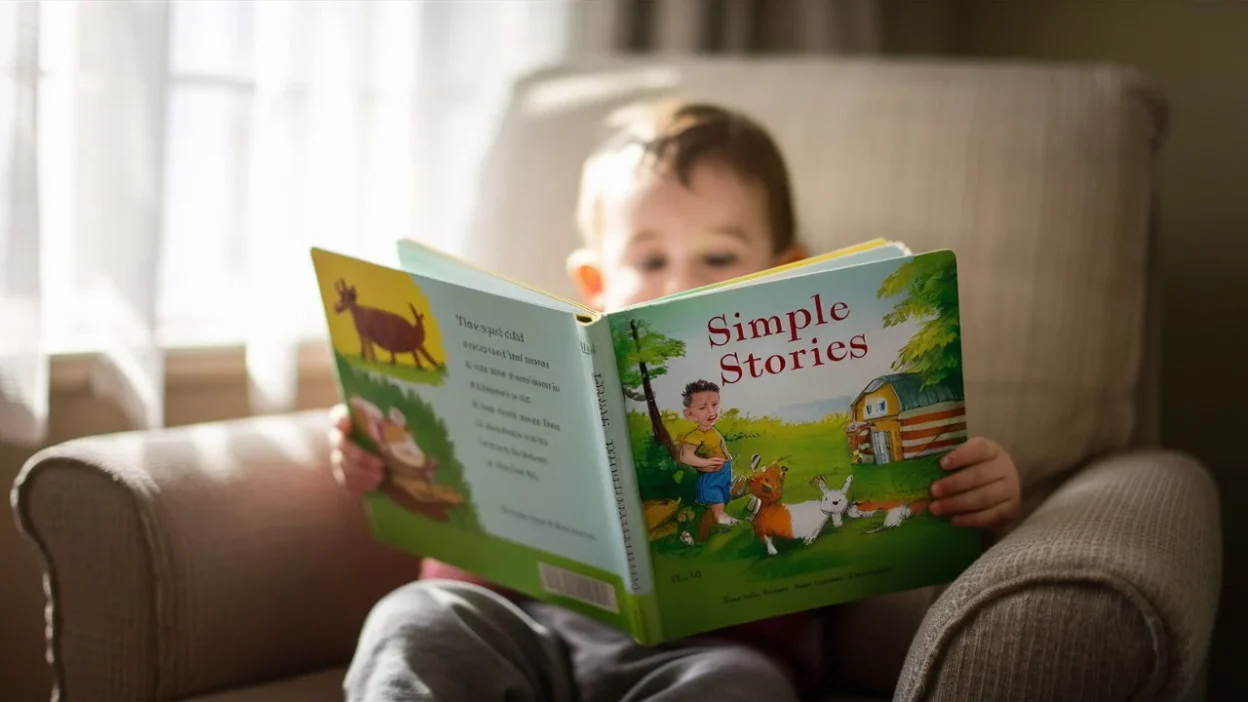
This collection of simple stories is perfect for readers of all ages. Each story is easy to understand, engaging, and teaches valuable life lessons. Through adventures, challenges, and small acts of kindness, these stories inspire courage, patience, empathy, and positivity.
Whether you are reading to yourself or sharing with children, these tales encourage learning, imagination, and growth. Every story concludes with a moral, making them both entertaining and meaningful.
Story 1: The Lost Little Cloud
High above the bright blue sky lived a fluffy little cloud named Softy. Softy was small, round, and always happy. He floated with the bigger clouds every day, watching the world below. But one windy afternoon, a strong gust pushed Softy far away from his cloud friends. Before he knew it, he was drifting alone over a strange valley he had never seen before.
Softy felt scared. He didn’t know which direction to go. The sky looked huge, and everything below looked unfamiliar. He called out, “Cloud friends! Where are you?” but his tiny voice only echoed against the mountains.
As Softy drifted lower, he saw a group of birds resting on a tall tree. He floated closer and asked politely, “Excuse me, do you know how I can get back to the big cloud group?”
The birds chirped kindly, “Follow the sun when it rises in the morning. It always shines near the big cloud groups.”
Softy thanked them and waited through the night. When the sun finally rose, its warm golden rays pointed right toward the horizon. Softy floated slowly, following the light, hoping he was moving in the right direction.
Along the way, he passed over lakes, meadows, and forests. He met a playful wind who asked where he was going. When Softy explained he was lost, the wind laughed gently and said, “Don’t worry! I know the way.” With a swirl, the wind guided Softy through the sky until Softy finally spotted his cloud friends.
They welcomed him with soft puffs and joyful swirls. Softy felt relieved, happy, and grateful. He realized that even when he was lost, kindness from others helped him find his way home.
Moral: Kindness and guidance from others can help us when we feel lost.
Story 2: The Brave Little Seed
Once upon a time, in a quiet garden behind a small house, lived a tiny seed named Sprig. Sprig was smaller than all the other seeds. The bigger seeds teased him, saying he would never grow tall or strong.
One day, a heavy rainstorm began. The soil shook, the wind howled, and many seeds were frightened. Sprig felt afraid too, but he whispered to himself, “I will stay strong. I will not give up.”
When the rain stopped, the sun peeked out and warmed the ground. Sprig felt a gentle push inside him, telling him to grow. Slowly, he sent out a tiny root. Then a thin shoot. Day after day, Sprig pushed himself upward, stretching toward the sunlight.
The bigger seeds grew faster at first, but Sprig never compared himself to them. Instead, he focused on small steps—just a bit more each day. He drank water when it rained, soaked up sun when it shined, and stood tall even during windy days.
As the weeks passed, Sprig grew into a beautiful little plant. He wasn’t the tallest or biggest, but he was strong, bright, and full of life. The gardener noticed him and said, “You are the bravest little plant I’ve ever seen.”
Eventually, Sprig bloomed a tiny yellow flower. It glowed softly in the garden, and all the other plants admired how determined he was.
Sprig realized something important: He didn’t need to be big to be special. He just needed to be himself and keep trying.
Moral: Growth happens when you stay patient and believe in yourself.
Story 3: The Helpful Little Lantern
In a quiet village stood an old lighthouse with a little lantern named Luma. Luma loved shining her warm golden light every night. She wasn’t very big or bright, but she always tried her best to guide sailors safely to shore.
One evening, a thick fog rolled in, covering the ocean like a gray blanket. The big lighthouse light suddenly stopped working! The villagers panicked. “How will the ships find their way?” they cried.
Luma felt nervous. She was only a small lantern. But she decided she couldn’t just sit and watch. “I will help,” she said bravely.
The keeper placed Luma at the highest window of the lighthouse. She glowed as brightly as she could, pushing her light through the fog. It wasn’t easy—the fog was heavy, and the night was dark. But Luma refused to give up.
Out at sea, Captain Rowan struggled to see anything. Waves crashed around his ship. Suddenly, he spotted a tiny golden flicker. “A light!” he shouted. “Follow it!”
Slowly but surely, the ship followed Luma’s glow until it reached the safety of the harbor. The villagers cheered and clapped. Luma felt warm with pride.
From that night on, everyone in the village admired Luma for her courage and kindness. Even a small lantern can shine brightly in someone’s darkest moment.
Moral: You don’t have to be big to make a big difference.
Story 4: The Turtle Who Wanted to Run
Toby was a small turtle who lived near a peaceful pond. Every day, he watched the rabbits race across the field. They ran so fast that Toby could barely keep track of them. Toby often sighed and said, “I wish I could run like that.”
One sunny morning, Toby told his best friend Lily the duck, “I want to learn how to run fast.” Lily quacked softly and said, “But turtles are meant to move slowly.” Toby shook his head. “Maybe, but I still want to try.”
So Toby began practicing. He took small steps first, trying to move quicker each day. The rabbits laughed when they saw him. “Look at Toby! He thinks he can run!” But Toby ignored them and kept moving.
Every morning, Toby woke up early and stretched his little legs. He walked, jogged, and even tried hopping, though he fell every time. Lily supported him, cheering from the edge of the pond.
Weeks passed. Toby grew stronger. One day, the rabbits challenged him to a short race. “You’ll lose,” they giggled. Toby simply nodded. “Maybe. But I’ll still try.”
The race began. The rabbits zoomed ahead, but Toby moved at his own pace—steady and determined. Halfway through the race, the rabbits became tired and stopped to rest. Toby kept going, slow but steady.
To everyone’s surprise, Toby crossed the finish line first. The animals cheered. The rabbits apologized for laughing at him. Toby smiled and said, “I didn’t win because I was fast. I won because I didn’t stop.”
From that day on, Toby became the hero of the pond. He still moved slowly, but he walked proudly, knowing he had done something special.
Moral: You don’t need speed to succeed—just determination and consistency.
Story 5: The Little Star Who Couldn’t Shine
In the quiet night sky, a tiny star named Nova twinkled softly. The other stars sparkled brightly, lighting up the darkness, but Nova’s glow was faint. She felt embarrassed and hid behind a passing cloud.
One night, the Moon noticed her sadness. “Why are you hiding, little one?” he asked gently. Nova whispered, “I can’t shine like the others. I’m too dim.”
The Moon smiled kindly. “Every star shines in its own time. Don’t give up.”
Nova tried hard to shine, but no matter how much she tried, her light stayed small. She watched the bigger stars guide travelers, inspire wishes, and brighten the sky.
One evening, a shooting star zoomed past and accidentally blew Nova off her spot. She tumbled downward until she floated just above a dark forest. The forest had no light—only deep shadows.
Nova gulped. “I can’t shine here,” she said nervously. But as she looked closely, she saw tiny animals struggling to find their way. A baby deer cried because it couldn’t see its mother.
Nova took a deep breath and glowed with all her strength. Her little light shone brighter than it ever had. It wasn’t huge, but it was enough. The forest lit up gently, and the animals found their way safely.
The Moon beamed proudly. “See, Nova? Your light was needed exactly where it mattered.”
Nova returned to the sky with confidence. From then on, she shined without fear—small, but full of purpose.
Moral: Even a small light can brighten someone’s darkness.
Story 6: The Curious Little Robot
Rilo was a small blue robot who lived in a workshop filled with tools, gears, and machines. Unlike the other robots, who followed instructions perfectly, Rilo was curious. He loved asking questions like, “Why do wheels spin?” and “How does a clock tick?”
The other robots didn’t understand him. “Robots don’t ask questions,” they said. But Rilo continued exploring. One day, he found a strange metal box with a button. “What does this do?” he wondered.
He pressed the button, and the box began to vibrate. Suddenly—POP! Springs, lights, and gears burst out, forming a tiny mechanical bird. The bird chirped and flew happily around the workshop.
Rilo was amazed. “I discovered something wonderful!” he shouted. But the other robots shook their heads. “You’re too curious. You’ll break something someday.”
A week later, the workshop’s main machine stopped working. The robots panicked. “We must follow the manual,” they said. But the manual had missing pages. No one knew what to do.
Rilo stepped forward. “Let me explore it.” The robots hesitated, but there was no other choice.
Rilo examined the machine carefully. He asked questions, tested gears, and followed wires. Finally, he found the problem: a tiny screw had come loose deep inside the machine.
Using his small hands, Rilo tightened it. The machine roared back to life. All the robots cheered.
“Your curiosity saved us!” they said.
Rilo smiled. From that day onward, the robots no longer discouraged questions. They learned that curiosity could lead to solutions no manual could give.
Moral: Curiosity leads to discovery and understanding.
Story 7: The Kind-Hearted Giant
(400 words)
In a faraway land lived a giant named Goro. He was tall, strong, and powerful—but he was also very gentle. The villagers feared him at first because of his size, but Goro never hurt anyone. He spent his days helping animals, planting trees, and fixing broken fences.
One morning, Goro heard shouting from the village. When he reached the main square, he saw people trying to rebuild a house that had collapsed in a storm. The villagers were struggling with the heavy beams.
Goro knelt down and said, “May I help?” The villagers hesitated. He looked scary, but they needed help. Finally, they nodded.
Goro lifted the beams easily, holding them in place while the villagers hammered nails. Children watched in amazement. “He’s not scary at all,” one said. “He’s helping us!”
Over the next few weeks, Goro repaired roads, carried water barrels, and even helped farmers plow their fields. Slowly, the villagers began trusting him.
One day, a fire broke out in the forest. The flames spread quickly toward the village. People screamed and ran, unsure of what to do. Goro ran into the forest, scooping up dirt and throwing it on the flames. He uprooted a huge tree and used its trunk to push burning branches away from homes.
By sunset, the fire was gone. The villagers hugged each other in relief.
The mayor stepped forward and said, “Goro, we were wrong to fear you. Your heart is bigger than your size.”
Goro smiled, happy that he had finally earned their trust.
From that day on, the villagers treated Goro as a friend and hero.
Moral: Don’t judge someone by their appearance—true worth is found in their actions.
Story 8: The Boy Who Shared His Smile
In a little town filled with busy people lived a boy named Sami. Sami didn’t have many toys, fancy clothes, or special things—but he had one gift that made him stand out. He had the warmest, brightest smile anyone had ever seen.
Every morning, Sami walked to school with a smile on his face. He smiled at the shopkeeper, the bus driver, the old woman who sat near the bakery, and even at strangers passing by. Most people smiled back, though some were too tired or too worried to notice.
One day, Sami saw his classmate Rafi sitting alone. Rafi always looked sad and never talked to anyone. Sami sat beside him and gave him his biggest smile. “Hi, Rafi! Want to play with me?” Rafi looked up, surprised. Nobody ever spoke to him kindly before.
At first, Rafi didn’t smile. But Sami didn’t give up. He shared his lunch with him, helped him in class, and told him funny stories. Slowly, Rafi began to laugh again. Soon, they became best friends.
Sami didn’t know that Rafi had been feeling lonely for a long time. His smile was the first bit of kindness Rafi had received in weeks, and it changed everything.
Word spread around the school about how Sami always made people feel better. Students who fought with each other suddenly began saying sorry. Teachers began smiling more too. Even the grumpy gatekeeper started waving happily whenever Sami passed by.
One afternoon, Sami caught a cold and stayed home. The school felt unusually quiet. “Where’s Sami?” the children asked. “It feels strange without his smile.”
So the students came up with an idea. They made a big poster that said, “Get well soon, Sami! From your smiling school.” Everyone drew a smiley face and signed their names. When Sami returned, he found the poster hanging above his desk. His heart swelled with happiness.
Sami realized something important: A simple smile can spread farther than he ever imagined.
Moral: A simple smile can brighten someone’s whole day.
Story 9: The Cat Who Wanted to Fly
In a cozy neighborhood lived a fluffy gray cat named Miso. Miso loved exploring rooftops, chasing butterflies, and taking long naps in the sun. But there was one thing she wanted more than anything: she wished she could fly like the birds.
Every morning, Miso watched sparrows flap their wings and soar through the sky. She would climb the highest wall and jump, hoping to glide. But every time, she landed safely on the grass—no flying, just falling gently.
Miso refused to give up. She practiced jumping from small boxes, then from taller fences. The other cats laughed. “Cats don’t fly!” they meowed. But Miso believed she could find a way.
One day, she met an old owl named Olan sitting on a branch. “Why do you keep trying to fly?” Olan asked kindly.
Miso replied, “Because it looks beautiful. I want to see the world from the sky.”
Olan nodded wisely. “Maybe you weren’t made to fly, but there are other ways to see the world differently.”
The next day, Olan invited Miso to sit on his back. With a gentle flap of his wings, he lifted off the ground. Miso held on tight as they soared above houses, fields, and rivers. Her eyes sparkled with joy.
“This is amazing!” she cried.
After the ride, Miso thanked Olan. She realized she didn’t need wings of her own—she just needed a new perspective.
From that day on, Miso helped other animals reach places they couldn’t on their own. She showed turtles where the best sun spots were, guided puppies to hidden gardens, and even helped ducklings find their way back to the pond.
Miso never flew herself, but her dream had opened a new path for her—to help others discover beauty in their own way.
Moral: Even if you can’t do something your way, you can still find another way to achieve your dream.
Story 10: The Rainbow That Forgot Its Colors
Far above the world, after every rainfall, a bright rainbow appeared. Its colors—red, orange, yellow, green, blue, indigo, and violet—shined beautifully. But one morning, after a heavy storm, the rainbow woke up confused. Its colors had faded!
“I can’t shine,” the rainbow whispered sadly. “Without my colors, what am I?”
Clouds drifted by but didn’t know how to help. The sun tried warming the rainbow, but the colors didn’t return. Feeling embarrassed, the rainbow hid behind a mountain.
Down below, a little girl named Amina wondered why the sky looked empty. She loved rainbows. They made her happy. She decided to climb the hill to see what was wrong.
When she reached the top, she found the rainbow hiding. “Why are you hiding?” she asked softly.
“I lost my colors,” the rainbow replied. “I don’t want anyone to see me like this.”
Amina smiled gently. “You don’t need colors to be special. But if you want them back, maybe I can help.”
Amina ran back to her village and gathered buckets of red berries, orange marigolds, yellow daisies, green leaves, blue shells, indigo stones, and violet petals. She carried them to the hill and placed them under the rainbow.
“Here,” she said. “Maybe the world can share its colors with you.”
The rainbow felt touched. As sunlight passed through the colorful collection, the colors reflected upward—slowly filling the rainbow’s arches again. Red returned first, then orange, yellow, green, blue, indigo, and finally violet.
The rainbow glowed brighter than ever before.
“You helped me shine again,” the rainbow said gratefully.
Amina replied, “Sometimes we all need a little help to find our colors.”
Moral: Everyone needs support sometimes—kindness can bring back someone’s brightness.
Conclusion
These 10 simple stories remind us that even small actions can create big impacts. From kindness and courage to curiosity and determination, each tale teaches an important lesson for life.
They show that challenges can be overcome, dreams can be achieved, and helping others always matters. By reading and sharing these stories, we can nurture empathy, positivity, and hope in ourselves and others, making the world a brighter, kinder place for everyone.