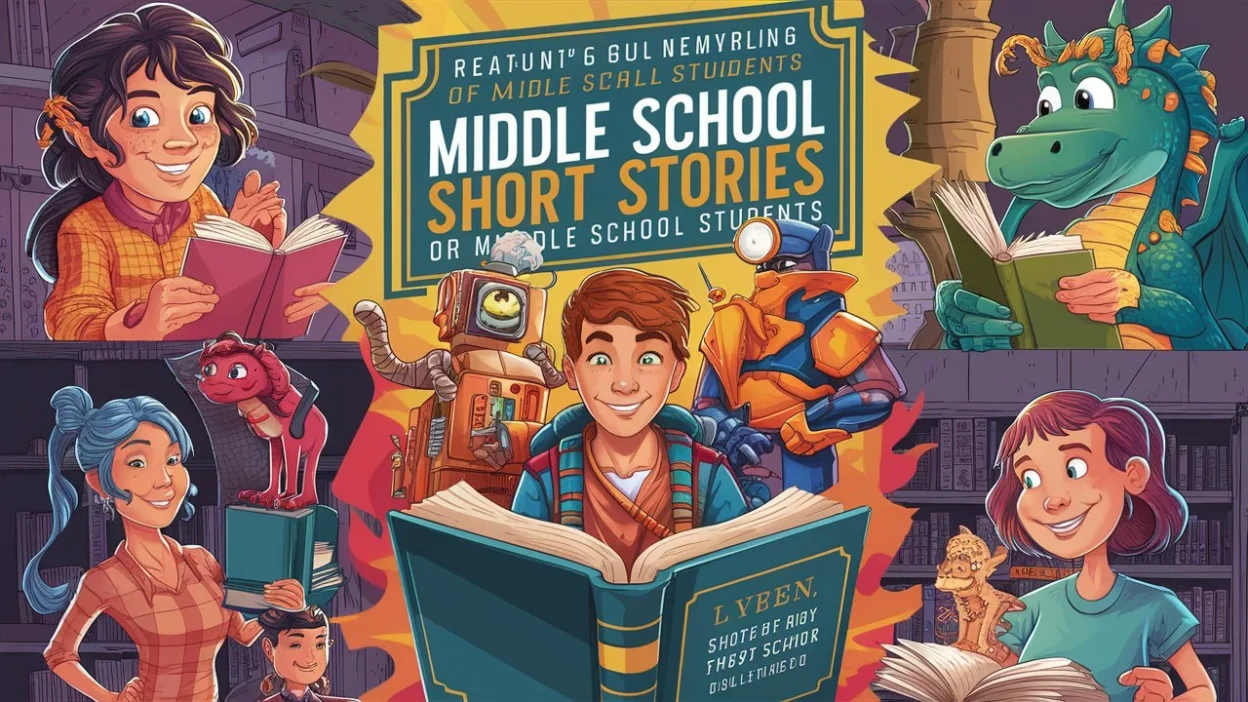
Middle school students love stories that are fun, meaningful, and easy to understand. That’s why this collection of short stories for middle school is written in a simple, clear, and engaging way.
Each story is around 400 words and ends with a strong moral lesson that young readers can easily connect with. These stories encourage imagination, kindness, courage, and responsibility while keeping the reader entertained from start to end.
Story 1: The Mysterious Locker
Liam was a sixth grader who loved solving puzzles. One day, while walking down the hallway, he noticed a locker slightly open, shining a faint blue light from inside. The number on it—113—wasn’t even on the school’s locker list. Curious, Liam pushed it open and found a tiny glowing box sitting on the shelf.
Inside the box was an old key and a note saying: “This unlocks courage. Find where it belongs.”
Liam’s heart raced. What did that mean? He slipped the key into his pocket and decided to search the school. He tried the key on classroom doors, storage rooms, and even teachers’ cabinets, but none fit. After school, he wandered near the gym and noticed a small wooden chest hidden behind the bleachers.
Hand shaking, he inserted the key. It turned smoothly.
Inside the chest was a mirror with words carved around it: “Courage begins when fear ends.” Liam stared at his reflection. He remembered how he always wanted to try out for the school debate team but was too afraid of messing up.
At that moment, Mrs. Kent, the debate coach, walked by and saw him.
“What brings you here, Liam?” she asked gently.
He took a deep breath. I want to try out. I think I’m ready.”
Mrs. Kent smiled. “Then courage has found you at the right time.”
From that day on, Liam practiced hard. He didn’t win first place, but he stood on stage fearlessly—and that was his real victory.
Moral: Real courage is choosing to try, even when you’re scared.
Story 2: The Tree That Heard Everything
Maya loved reading under the giant oak tree behind her school. She believed the tree was magical because whenever she was sad, the wind seemed to whisper comforting words through its leaves.
One afternoon, Maya overheard two classmates arguing. One boy, Amir, accidentally broke Sam’s science project, and Sam angrily shouted at him in front of everyone. Amir ran off crying.
Maya walked to the oak tree and sighed, wishing she could help. Suddenly, she noticed something carved into the bark: “Listen first. Speak second.”
She realized the message was meant for her.
She found Amir sitting alone. “What happened?” she asked.
“It was an accident,” Amir whispered. “But he didn’t let me explain.”
Maya then approached Sam. “You didn’t listen to him,” she said softly. “The tree taught me something today. Maybe you should hear him out.”
Sam hesitated but finally agreed. When Amir explained everything, Sam’s anger melted into guilt. They fixed the project together, and both apologized.
That afternoon, Maya sat again under the oak tree. A breeze swept by, and she smiled. Maybe the tree really could hear everything.
Moral: Many problems can be solved simply by listening.
Story 3: The Lost Homework Adventure
Eva was famous for losing her homework. She didn’t do it on purpose—papers just seemed to disappear around her. This time, she had worked extra hard on her history assignment, but when she checked her backpack, it was gone again.
Panicked, Eva retraced her steps: the playground, the cafeteria, the art room. Nothing.
Finally, she checked the library. The librarian, Mrs. Willow, said she hadn’t seen it, but encouraged Eva to keep searching.
As Eva walked to the reading corner, she spotted a small trail of colorful stickers—the ones she used to decorate her notebook. The trail led behind a bookshelf, and there it was: her missing homework… sitting in a box with a tiny kitten curled on top of it!
The poor kitten looked hungry and scared. Eva forgot her frustration and gently picked it up. Mrs. Willow helped her take the kitten to the local animal shelter.
The next day, Eva handed her homework to her teacher and told her the whole story.
Her teacher smiled. “You may lose homework, Eva, but you never lose your kindness.”
Moral: Sometimes mistakes lead to unexpected good deeds.
Story 4: The Secret of the Old Compass
Noah loved exploring, and he always carried his grandfather’s old compass. One day, during a school field trip to the nearby woods, Noah noticed the compass needle spinning wildly. Curious, he followed it, leaving the group behind.
After a while, he stumbled upon a hidden path leading to a small, abandoned cabin. Inside, he found dusty books, maps, and a journal. The journal belonged to an explorer who had once lived there, filled with notes about hidden treasures and the importance of honesty and perseverance.
Noah realized the compass didn’t just point north—it pointed to discoveries that mattered most to the heart. He carefully took the journal to his teacher, who praised his honesty and curiosity. The school later displayed the journal for everyone to learn from.
Moral: True adventure lies in honesty, curiosity, and doing what is right.
Story 5: The Painting That Came Alive
Lila loved art class, especially painting. One afternoon, she painted a bright forest scene with animals and a sparkling river. When she returned the next day, she noticed something strange—the painting shimmered!
Suddenly, a tiny bird flew out of the canvas, chirping happily. Lila gasped but realized the bird needed help. She followed it to the school garden, where she found a baby bird that had fallen from its nest.
Thanks to Lila’s quick thinking, she safely returned the bird to its nest. From then on, every painting she created reminded her that art could inspire action, not just admiration.
Moral: Creativity is powerful when combined with kindness and care.
Story 6: The Homework Club Mystery
Sam and his friends started a homework club to help students complete assignments on time. Everything was running smoothly until someone began stealing papers from the table.
Determined to find the culprit, Sam set up a plan. He hid a notebook with a small bell inside. The next day, he heard the bell jingling and followed the sound. To his surprise, it was Emma, a shy girl too afraid to ask for help.
Instead of scolding her, Sam invited her to join the club properly. Emma’s confidence grew, and she started helping other students. The club became stronger than ever.
Moral: Understanding and patience often solve problems better than anger.
Story 7: The Day the Music Stopped
During music class, the school’s piano suddenly broke, leaving everyone in silence. Max, who had always wanted to play, was disappointed.
He decided to create music differently. Using classroom objects—desks, pencils, and even lunch trays—he tapped out a rhythm. Soon, other students joined, forming an improvised band.
Even without the piano, the class discovered that music was not about instruments, but about creativity and teamwork.
Moral: Challenges can inspire new solutions if you stay positive and creative.
Story 8: The Lost Puppy Adventure
One rainy afternoon, Mia was walking home from school when she heard soft whimpers near the bushes. Investigating, she found a tiny, shivering puppy. It had no collar and looked very scared.
Mia picked up the puppy and ran home. Her parents helped her dry it off and gave it some food. The next day, Mia made posters and asked neighbors if anyone had lost a dog. After two days, they found the owner, a little boy named Leo, who had been worried sick.
Leo hugged his puppy tightly. “Thank you for taking care of him,” he said. Mia felt proud and happy that she had helped.
Moral: Helping those in need, even animals, shows kindness and responsibility.
Story 9: The Science Fair Surprise
Ethan was nervous about the school science fair. He had spent weeks creating a volcano project, but on the day of the fair, his experiment failed. Lava didn’t flow, and he felt embarrassed.
His friend Sara encouraged him: “It’s okay! Maybe your project can teach others something too.” Ethan shared what went wrong and explained what he had learned during the experiment.
To his surprise, the judges praised his honesty and problem-solving skills. Ethan didn’t win first place, but he gained confidence and respect from his classmates.
Moral: Mistakes are opportunities to learn and grow.
Story 10: The Friendship Bracelet
Nina and Ayesha were best friends. They loved making friendship bracelets for each other. One day, Ayesha moved to another city. Nina felt lonely and sad.
Instead of giving up, Nina decided to send a bracelet every month, each with a small note. Ayesha replied with her own bracelets and letters. Through their bracelets, they shared stories, dreams, and laughter, staying connected despite the distance.
Their friendship became stronger, teaching them that true bonds survive time and space.
Moral: True friendship endures challenges and distance.
Conclusion
These short stories for middle school teach valuable lessons about courage, kindness, creativity, honesty, and friendship. Each story encourages young readers to reflect, imagine, and grow while enjoying fun and engaging tales.