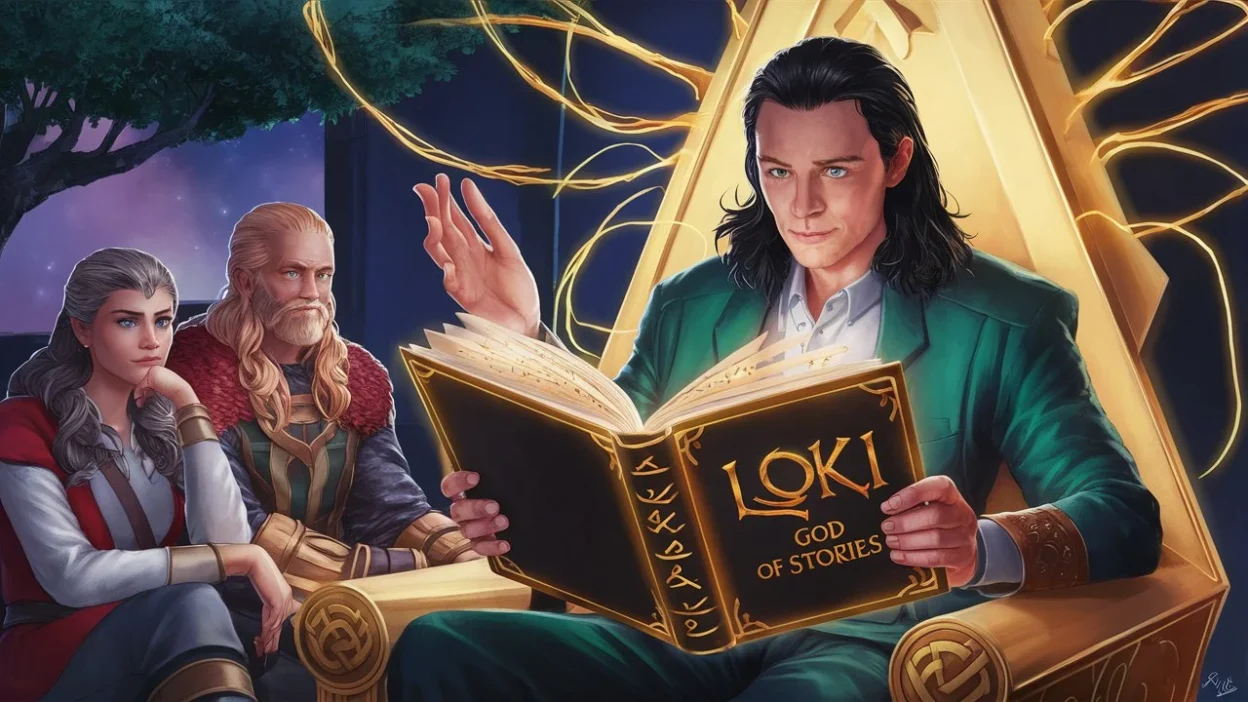
For fans of mythology, Marvel enthusiasts, and readers who crave clever, twist-filled storytelling, this collection of Loki God of Stories tales is here to amaze. As the MCU’s Loki evolves into the God of Stories, his journey has inspired countless new interpretations—mixing Norse myth, comic book arcs, and the latest trending fan discussions of 2025.
These stories dive into Loki’s trickster heart, his newfound powers, and his role as a storyteller shaping fate itself. Perfect for adults who want engaging, myth-rich narratives, each one reflects Loki’s wit, chaos, and surprising wisdom. Along the way, you’ll encounter references to Loki God of Stories comic, the MCU’s latest arcs, and a glimpse of how his powers make him one of the most fascinating characters today.
Story 1: The Threads of Yggdrasil
Loki stood at the roots of Yggdrasil, the World Tree, weaving tales into its bark. Each word etched itself into reality. He smiled, for this was his gift—the power to tell stories that could shape destiny itself. Odin once bound him, Thor once struck him, but now he held a quill sharper than any spear.
Mortals whispered that the God of Stories could change the past with a sentence and the future with a paragraph. That day, he tested it. Loki wrote: “A world where Asgard never fell.” A golden vision shimmered, but the people within were hollow, lifeless puppets.
He paused, then sighed. Power without heart was nothing. Instead, he carved: “A world where every story teaches.” The shimmering realm brightened, mortals laughed, cried, and learned. Yggdrasil pulsed with life.
Loki closed the book of fate, knowing that chaos might tempt him, but wisdom would guide him.
Moral: True stories are not about control, but about meaning.
Story 2: The Mask of Mortals
In Midgard, Loki wore the face of a wandering bard. No one recognized him as the God of Stories—just another performer spinning tales in taverns. He sang of heroes, villains, and betrayals. But each story carried hidden truths: warnings of greed, whispers of fate, hints of futures unwritten.
One night, a cruel lord demanded he tell a tale glorifying his rule. Loki bowed, lips curling with mischief. He wove a story of a king who built towers so high they scraped the sky—yet fell because he ignored the cries of his people. The tavern grew silent. The lord paled.
The next morning, the tyrant lowered taxes, fearful of becoming that doomed king. Loki grinned, knowing he had bent power without raising a blade.
Moral: Words can topple thrones more swiftly than swords.
Story 3: The Library of Endings
Deep beyond Asgard’s ruins lay a hidden library where every story ended. Loki, now God of Stories, entered its halls. Scrolls glowed with unwritten destinies.
One scroll bore his name. He unrolled it—his end was blank. Loki laughed, delighted. Here, he was untethered. Unlike Thor, unlike Odin, his fate was a canvas waiting for ink.
He began writing endings for forgotten souls: a warrior who died nameless gained honor, a lonely child found companionship, a world destroyed found rebirth. Each story rewrote pain into hope.
But when he tried to pen his own fate, the ink vanished. A whisper echoed: “The storyteller cannot write his own ending.”
Loki smirked. “Then I’ll keep telling stories forever.”
Moral: Some endings remain unwritten so that hope may endure.
Story 4: The Trick in the Multiverse
In the vast expanse of the multiverse, Loki walked between worlds. Each realm carried its own myths: in one, he was a savior; in another, a betrayer. But now, as the God of Stories, he held the power to thread them all together.
He found a world where Thor died as a boy. Its people mourned endlessly, their skies forever gray. Loki whispered into the fabric of that universe, weaving a tale of a hero born from grief. The clouds parted, and hope returned.
But in another universe, he was tempted. He could erase his worst mistakes—undo betrayals, rewrite trust. Yet he paused. If he erased his flaws, would he still be Loki?
With a laugh, he left the stories intact. Imperfection, after all, was what made tales worth telling.
Moral: Our flaws are chapters that make the story complete.
Story 5: The Game of Gods
Odin, Frigg, Thor, and the old pantheon gathered around a table. Loki had summoned them—not for war, but for a game. Cards and dice sprawled across the board, each piece representing realms, mortals, and fates.
The others scoffed. “What use is this?” Thor demanded.
But as the game unfolded, they realized Loki’s intent. Every card revealed truths: pride, sacrifice, betrayal, love. Thor’s mighty hammer was just a pawn without courage behind it. Odin’s wisdom faltered when faced with empathy.
By the game’s end, they sat humbled. For once, Loki hadn’t tricked them with lies—he’d shown them mirrors of themselves.
And when they rose from the table, the All-Father whispered, “Perhaps stories hold more power than war.”
Moral: Stories reveal truths even gods cannot ignore.
Story 6: The Tale Stolen by Silence
One night, Loki discovered a thief. A faceless shadow crept into his archives and stole a story from his book of fates. Curious, Loki followed.
The thief fled into a desolate realm where silence devoured every word. No songs, no whispers, no stories. Loki realized this was a world forgotten, where tales went to die.
He confronted the shadow, who wept. “I stole to remember. My people are voiceless.”
Moved, Loki sat beside the faceless one. He spoke their name, their history, their laughter. The silence trembled, cracked, and then shattered as stories burst forth like rivers.
The thief knelt, no longer faceless, but whole.
Moral: A forgotten story is a world waiting to live again.
Story 7: The Story Carved in Stone
High in Jotunheim, the frost giants chiseled their victories into mountainsides. Their history was stone, cold and unchanging. Loki, half-giant himself, wandered among them.
He touched the carvings and whispered. The stones stirred, reshaping. Suddenly, forgotten names appeared—giants who sacrificed for love, for peace, not just for war. The elders roared in anger. “You rewrite our truth!”
Loki only smiled. “A story told by one voice is not truth—it is propaganda.”
When children came to read the carvings, they found not just battles but kindness, laughter, and dreams. The future shifted, ever so slightly, because one god dared to add missing chapters.
Moral: History belongs to all, not just the victors.
Story 8: The Firefly’s Lesson
Loki once trapped a firefly in a jar to see if its glow could outshine the stars. Yet the jar dimmed the light.
So he whispered a story of freedom, opening the lid. The firefly flew into the night, weaving sparks across the dark sky. Villagers looked up, inspired to light their own fires, share their own tales.
Loki realized then—power hoarded dims, but power shared ignites.
He left the jar empty, carrying instead the memory of how even the smallest spark could guide an entire world.
Moral: Shared stories shine brighter than those kept in cages.
Story 9: The Broken Quill
Once, Loki’s quill snapped. Without it, he could not write destiny. For the first time, he was forced to live un-scripted.
At first, panic gripped him. No control, no weaving of words, no safety in trickery. But then, he noticed life unfolding: a child laughing, a warrior stumbling yet rising, a lover forgiving betrayal. None of it was written—yet it was beautiful.
When the Norns repaired his quill, they asked if he wished to resume control. Loki tucked it away. “Sometimes the best story is the one that writes itself.”
Moral: Life unscripted is often the most beautiful tale.
Story 10: The Eternal Audience
At the edge of time, Loki sat before an audience of mortals, gods, and forgotten souls. He told stories—of chaos and love, of ruin and rebirth. They listened, captivated.
When his voice faltered, the audience began telling their stories back to him. Loki realized then: he was not the only storyteller. Every soul held a spark of narrative power.
Laughing, he declared, “Then the God of Stories is not me alone—it is all who dare to tell.”
And the cosmos shimmered, reborn in the voices of many.
Moral: We are all storytellers, shaping eternity with our words.
Conclusion
From Norse myths to the Loki God of Stories MCU arc, and from the Loki God of Stories comic to his evolving role in 2025’s hottest discussions, these tales show why Loki remains one of the most compelling figures. His powers are not merely tricks or illusions—they are the ability to shape meaning, history, and even multiverses through story itself. Whether you’re a fan of mythology, the MCU, or just great storytelling, Loki reminds us that every tale—ours included—matters.